How to Choose the Right Water Treatment System for Your Home
Most people don’t think much about their household water until it starts causing trouble. Maybe the shower door is covered in white…
Most people don’t think much about their household water until it starts causing trouble. Maybe the shower door is covered in white spots. Perhaps your coffee tastes slightly different, or the faucet seems to develop a crusty ring overnight. Then there are those little things you can’t quite explain—soap that doesn’t lather well, laundry that feels stiff, or appliances that need cleaning more often than they used to.
These signs don’t always point to the same problem. That’s an important thing to remember when you’re looking at water treatment options. A system that works wonderfully for one home may do very little for another.
Choosing the right solution starts with understanding what your water needs, what your household uses it for, and what kind of maintenance you’re willing to handle. Once those pieces are clear, the equipment becomes much easier to choose.
Start With the Problem, Not the Product
It’s easy to browse water treatment systems and get distracted by impressive specifications. Bigger tanks, more filtration stages, advanced controls—the list can go on.
But technology isn’t the starting point. Your water is.
Hard water, sediment, unpleasant taste, odors, and specific contaminants are different concerns. Treating them requires different approaches. Before spending money, have your water tested when appropriate and identify the issue you’re actually trying to solve.
This simple step can prevent a surprisingly common mistake: buying a system because it sounds good rather than because it matches the home’s conditions.
When a Water Softener Makes Sense
Hard water can be a quiet nuisance. You may not notice it immediately, but the evidence tends to appear over time.
Minerals such as calcium and magnesium can leave deposits on faucets, showerheads, glassware, and appliances. Soap may feel harder to rinse away. Water heaters and other equipment can also develop scale.
A water softener is designed specifically to reduce hardness minerals. Traditional ion-exchange softeners replace calcium and magnesium ions with sodium or potassium ions, helping prevent those minerals from accumulating throughout the home’s plumbing.
For households dealing with persistent scale, a properly sized softener can make everyday cleaning easier and may help protect water-using appliances from mineral buildup.
Still, don’t assume a softener is the answer to every water complaint. It has a specific job.
Whole-Home Filtration Has a Different Role
A softener and a filter aren’t interchangeable. This is where water treatment can get confusing for first-time buyers.
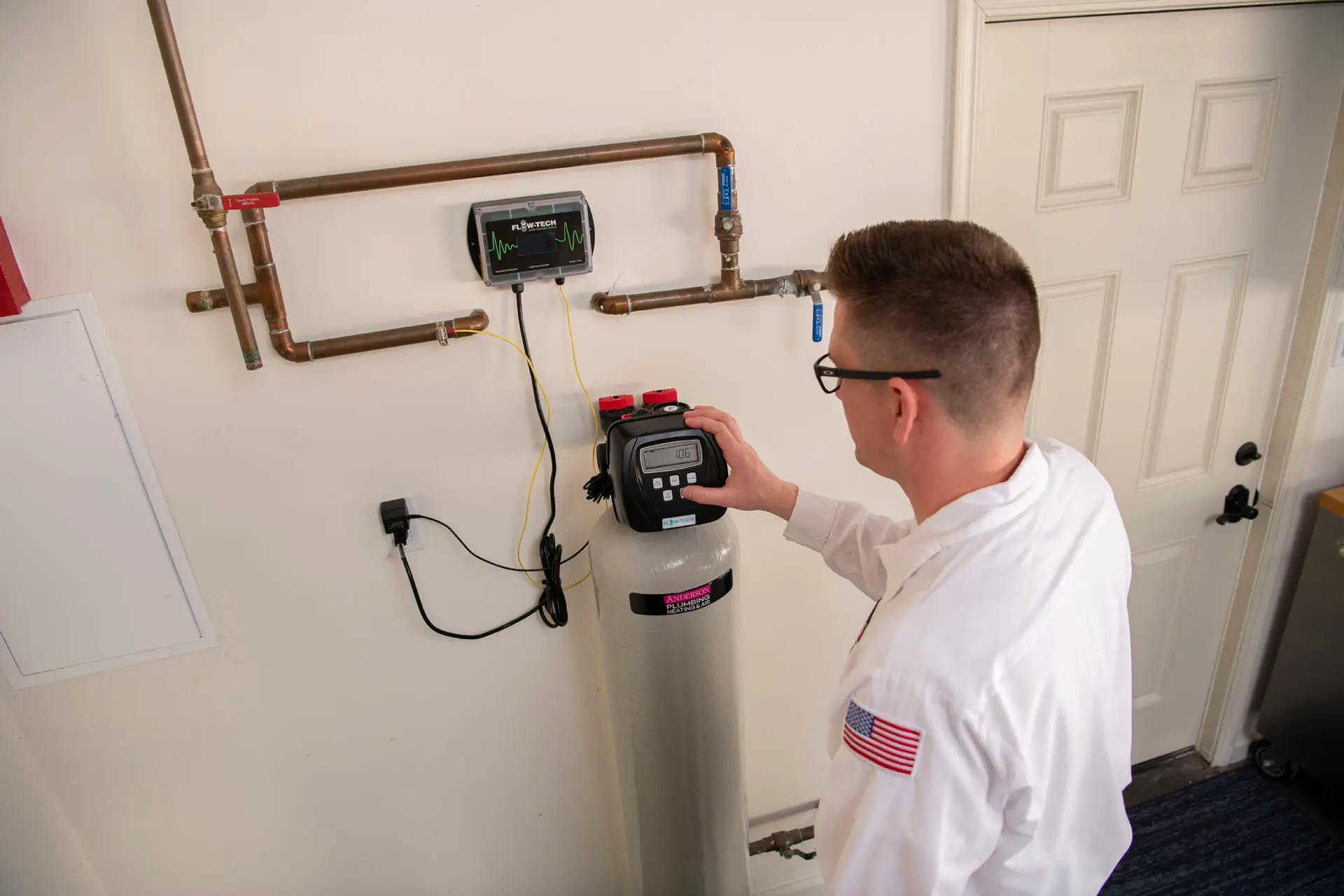
Whole-home filtration generally means treating water as it enters the house so that multiple faucets and fixtures receive treated water. Depending on the filtration technology, these systems can target things such as sediment, chlorine, taste and odor concerns, or other substances.
The exact performance depends heavily on the filter media and system design. A filter designed for sediment isn’t necessarily designed to address the same things as a carbon filter, specialty media system, or other treatment technology.
So, look closely at what a system is certified or designed to reduce. “Filtration” is a broad term, not a guarantee that every possible concern will be handled.
Don’t Forget the Water You Drink
Whole-house treatment isn’t always necessary for every drinking-water concern.
Some homeowners prefer a dedicated system at the kitchen sink. These systems can focus treatment where drinking and cooking water are used most often. Depending on the technology, options may include carbon filtration, reverse osmosis, or other point-of-use approaches.
The advantage is straightforward: you’re treating the water you actually consume without necessarily treating every gallon used for toilets, showers, or outdoor activities.
For families particularly concerned about taste, odor, or certain dissolved substances, drinking water systems can offer a targeted solution. The right technology, however, should always be selected based on the water and the desired treatment goal.
Think About Your Household Habits
Your daily routine matters more than you might expect.
A family of five with several bathrooms and frequent laundry loads will use water very differently from a person living alone. If everyone showers around the same time each morning, peak demand matters. If you regularly run a dishwasher and washing machine, that affects overall consumption too.
When choosing equipment, consider household size, water usage, flow rate, and available installation space.
A system that’s undersized may struggle during periods of heavy demand. A system that’s dramatically oversized may cost more than necessary.
Good sizing is about balance.
Installation Is Part of the Equation
Even the right equipment can disappoint when installation isn’t handled properly.
Treatment systems need correct plumbing connections, suitable drainage, appropriate pressure, and enough space for maintenance. Salt-based softeners also require a practical location for adding salt and managing regeneration.
Before installation, consider accessibility. You don’t want equipment tucked into an impossible corner where changing a filter becomes a wrestling match.
Professional installation can also help ensure the system is configured according to the home’s actual water conditions rather than simply switched on with factory settings.
Maintenance Isn’t Optional
Every treatment system has a maintenance routine. Some are simple. Others require more attention.
Filters eventually become loaded with the material they remove. Softener salt needs replenishment. Components may need inspection, cleaning, or sanitization. Settings can also require adjustment if household water usage changes.
One of the smartest things you can do before buying is ask about ongoing maintenance.
How often do filters need replacement? What do replacement cartridges cost? How frequently does the softener regenerate? Are service appointments required? Can homeowners perform routine tasks themselves?
These questions matter because the cheapest system isn’t necessarily the least expensive system to own.
Watch for Changes Over Time
Your water may not stay exactly the same forever.
Changes in taste, odor, pressure, or appearance can be worth investigating. If scale suddenly returns after months of good performance, there could be a maintenance issue or a change in water conditions.
Don’t automatically assume that a treatment system has failed. Check the basics first.
A clogged filter can reduce flow. Incorrect settings can affect a softener’s performance. A depleted filter cartridge may simply need replacement.
Paying attention early can save you from a larger repair later.
Don’t Buy More Than You Need
There’s a certain temptation with home equipment to believe that more is always better. More stages. Bigger capacity. More features.
Not necessarily.
A treatment system should solve a defined problem. If testing shows that hardness is the primary concern, start there. If taste is the issue, investigate filtration options suited to that concern. If there’s a specific contaminant, look for technology that is actually designed and appropriately certified for it.
A complicated system isn’t automatically a better system.
In fact, unnecessary equipment can create more maintenance and higher operating costs without providing meaningful benefits.
Make the Decision With the Long View
Price matters, of course. But it’s only part of the equation.
Think about installation, replacement filters, salt, electricity if applicable, servicing, expected equipment life, and warranty coverage. A system that costs a little more initially may prove easier to maintain and more practical over several years.
Also consider how your household might change. If you’re planning an addition, expecting a growing family, or renovating the plumbing, today’s ideal capacity may not be ideal forever.
A little planning can prevent another equipment purchase later.
Better Water Starts With Better Information
Choosing water treatment doesn’t have to feel like navigating a maze of technical jargon.
Start with the basics. Find out what’s happening with your water. Decide what you want to improve. Then choose equipment designed for that particular goal.
A softener can be useful for hardness. Whole-home filtration can address certain concerns across the house. Point-of-use drinking systems can provide targeted treatment where it matters most.
The smartest choice isn’t necessarily the newest system or the one with the most features. It’s the system that fits your water, your home, and your daily life.
Once you approach the decision that way, water treatment becomes much less about shopping and much more about solving a real household problem. And honestly, that’s how it should be.