Home Loan Interest Rates 2026: What You Need to Know
Been comparing home loan offers across three different bank apps and getting three completely different numbers? That's not you doing something wrong — home loan interest…
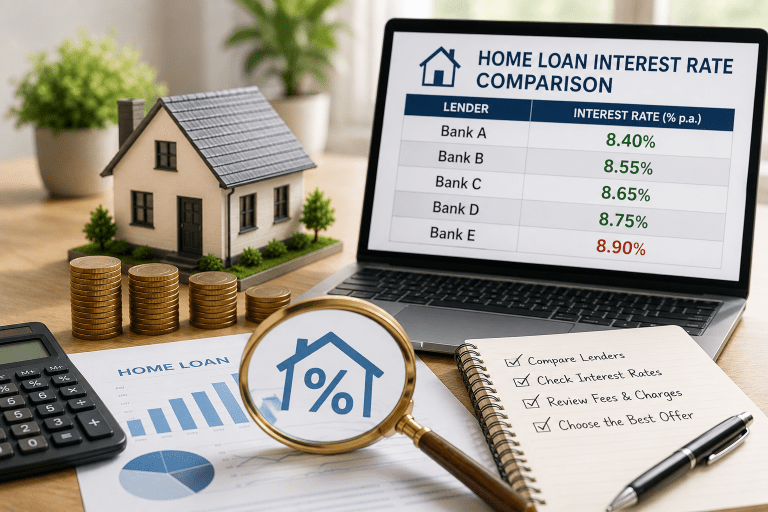
Been comparing home loan offers across three different bank apps and getting three completely different numbers? That’s not you doing something wrong — home loan interest rates 2026 genuinely vary this much depending on which bank you check, your credit score, and honestly, sometimes just which relationship manager you talk to.
I went through this exact confusion helping a friend shop for a home loan a few months back. The advertised rate on a billboard was nothing close to what she actually got quoted. This guide breaks down what’s really happening with rates right now, why they differ so much between banks, and how to make sure you’re not paying more than you need to.
Where Home Loan Rates Stand Right Now
Quick answer: As of mid-2026, home loan interest rates continue to remain competitive across banks and housing finance companies, with rates currently starting at 7.10% and going beyond 12% for certain borrower categories and lenders. Public sector banks generally offer the lowest starting rates.
This is a much wider range than most people expect walking in. The gap between the best rate and the worst isn’t small either — a difference of just 0.25-0.50% can increase total repayment by ₹2-6 lakh or more over a typical 20-30 year tenure. That’s not a rounding error, that’s real money.
Public Sector Banks: Usually the Cheapest Option
Quick answer: Public sector banks typically offer the lowest starting home loan rates, with several clustering around 7.10-7.25% for well-qualified borrowers, though rates can climb considerably higher for weaker credit profiles.
State Bank of India currently offers home loans in the range of 7.25-8.70%, regardless of loan size, while Bank of India, Bank of Maharashtra, Central Bank of India, and Indian Overseas Bank start from around 7.10%. Union Bank and UCO Bank start around 7.15%, and Punjab National Bank begins near 7.20% for loans above ₹30 lakh.
I’ve noticed people assume all PSU banks behave identically, but there’s real variation even within this category. Worth checking two or three, not just settling for the first one that quotes a decent number.
Private Banks: Slightly Higher, But Faster Processing
Private sector banks generally charge somewhat higher rates, with fewer lenders offering anything below 7.50%. ICICI Bank and HSBC currently start around 7.45%, Kotak Mahindra begins near 7.70%, HDFC Bank starts at roughly 7.90%, and Axis Bank sits in a similar range.
Picture a small business owner in Jaipur who needed loan approval within two weeks for a time-sensitive property purchase. She went with a private bank despite the slightly higher rate, purely because processing was faster and more predictable than the PSU option she’d initially considered. Sometimes speed genuinely outweighs the rate difference.
Why Your Actual Rate Differs From the Advertised One
This trips up almost everyone at some point. Banks advertise their lowest possible rate, but that’s reserved for borrowers with the strongest profiles.
- Credit score above 750 usually unlocks the best advertised slabs
- Lower scores push you toward the upper end of a bank’s range, sometimes several percentage points higher
- Self-employed applicants often face slightly higher rates than salaried applicants with comparable income
- Loan amount and property type also factor into the final quoted rate
Has this ever happened to you — seeing a headline rate of 7.10% only to get quoted 8.5% once you actually apply? It’s more common than the marketing suggests.
Fixed vs Floating: Which Makes Sense Right Now
Most home loans in India today run on floating rates linked to the RBI’s repo rate, which means your rate moves when the central bank adjusts policy. Fixed rates lock in a set rate for the entire tenure, or sometimes just an initial period before switching to floating.
Floating rates tend to work out cheaper over a long tenure historically, though they carry the uncertainty of rate hikes down the line. Fixed rates offer predictability, useful if you’re someone who wants a stable EMI figure to plan around regardless of what the RBI does next. I’ll be honest, I lean floating myself unless someone’s genuinely risk-averse about EMI fluctuations. [link to related guide on fixed vs floating home loan rates here]
How to Actually Get a Better Rate
A few practical steps make a real, measurable difference here.
- Check and improve your credit score before applying, not after getting quoted a high rate
- Compare at least 3-4 lenders, including both PSU and private banks
- Negotiate, especially if you have an existing relationship or a strong repayment history with a bank
- Consider a shorter tenure if you can manage higher EMIs, since it usually comes with marginally better terms
[link to related guide on improving credit score for loan approval here]
Refinancing: Is It Worth It in 2026?
If you took a home loan a few years back at a noticeably higher rate, refinancing to a current lower rate might make sense, especially with several PSU banks now under 7.5%. Run the numbers though — factor in processing fees and any prepayment charges on your existing loan before assuming it’s automatically worth switching.
FAQ: Home Loan Interest Rates 2026
Q: What is the current lowest home loan interest rate in India? Several public sector banks are currently offering starting rates around 7.10%, though this applies mainly to borrowers with strong credit profiles.
Q: Do home loan rates change during the loan tenure? Yes, for floating rate loans, since they’re linked to the RBI’s repo rate and adjust during periodic reset cycles.
Q: Is it better to choose a PSU bank or a private bank for a home loan? PSU banks generally offer lower starting rates, while private banks often process loans faster, so the right choice depends on your priority between cost and speed.
Q: How much can a good credit score actually save on a home loan? A strong score, generally 750 and above, can unlock a bank’s best advertised rate slab, potentially saving lakhs over a long tenure compared to a weaker score.
Q: Should I refinance my existing home loan in 2026? It’s worth considering if your current rate is significantly higher than what’s available now, though always factor in processing and prepayment charges before switching.
Q: How often do banks change their home loan interest rates? This depends on the RBI’s repo rate decisions and each bank’s specific reset cycle, which can range from monthly to quarterly for most floating rate loans.
Wrapping Up
Home loan interest rates 2026 vary more than most advertisements let on, with public sector banks generally leading on price and private banks often winning on speed. Your actual rate depends heavily on credit score, loan amount, and employment type, so don’t assume the billboard number is what you’ll get quoted.
Before signing anything, get quotes from at least three lenders and check today’s rates directly with each bank, since these figures shift with RBI policy changes. A half-hour of comparison now could genuinely save you lakhs over the life of the loan.